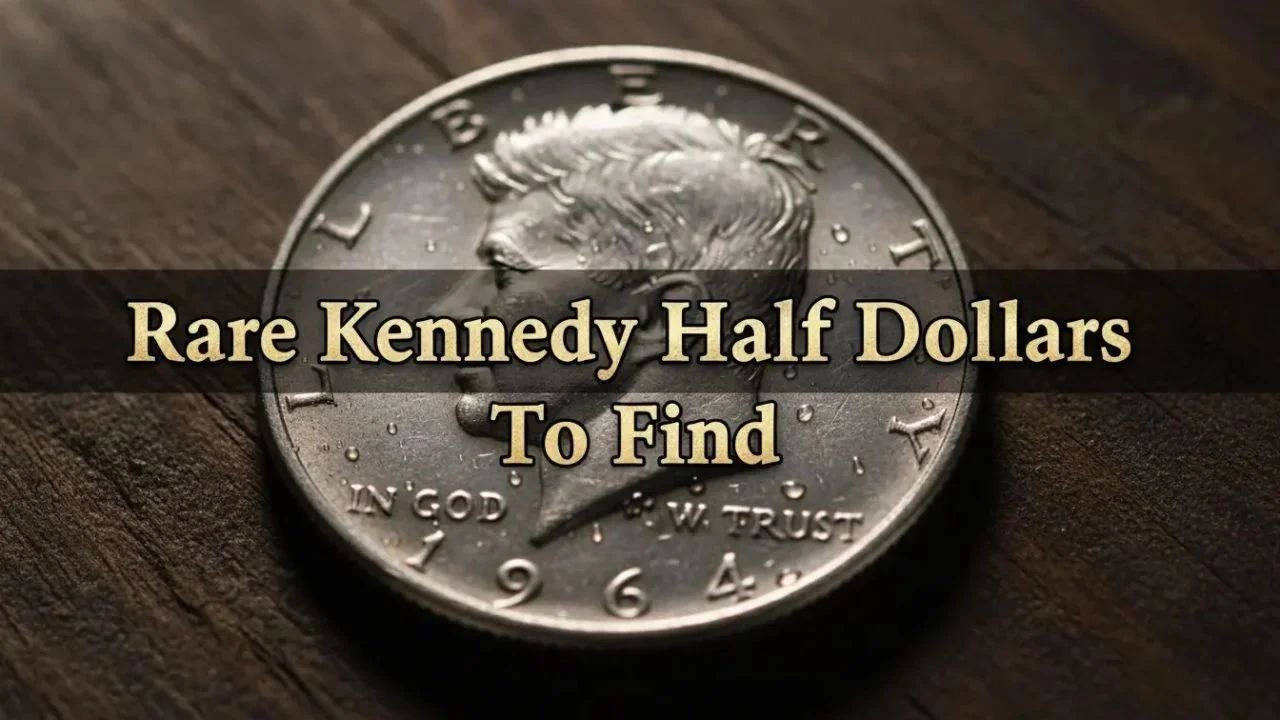
The Kennedy Half Dollar holds a unique position in American coin collecting. Introduced in 1964 to honor President John F. Kennedy shortly after his assassination, the coin carries deep historical significance alongside strong collector appeal. While most Kennedy Half Dollars are readily available and trade near face value or melt value, a select group of rare issues stands apart. These coins are prized for their condition, unusual minting characteristics, or verified errors, and they continue to inspire collectors around the world.
This guide explores the eleven rare Kennedy Half Dollars collectors dream of finding, explains why they matter, and outlines how to identify and evaluate them with confidence.
How to Use This Guide to Identify Rare Kennedy Half Dollars
Successful evaluation begins with three fundamentals: condition, mint characteristics, and minting errors. High-grade coins, special finishes, and authenticated varieties consistently bring the strongest premiums.
Use consistent lighting, a 10x magnifier, and trusted reference images from major grading services. Document anything unusual before seeking professional opinions. When a coin appears exceptional, third-party grading is the most reliable way to confirm authenticity and value.
1. 1964 Kennedy Half Dollar in High Mint State
The first-year Kennedy Half Dollar was struck in 90 percent silver and produced in enormous quantities. Despite this, truly high-grade examples with sharp strikes and clean surfaces remain difficult to find.
What to look for: Strong hair detail above Kennedy’s ear, minimal contact marks in the fields, and bright original luster. Value is driven almost entirely by condition rather than scarcity.
2. 1964 Doubled Die Obverse Varieties
Authentic doubled die obverse Kennedy Half Dollars from 1964 show clear, raised doubling caused during die creation. These are not strike-related distortions and are highly collectible when well defined.
What to look for: Visible doubling on the date, LIBERTY, or Kennedy’s profile. The doubling should appear rounded and distinct, not flat or shelf-like.
3. Repunched Mint Marks on Early Denver Issues
Before mintmarks were added mechanically, they were punched by hand, creating opportunities for repunched mint marks. Several early Denver Kennedy Half Dollars display collectible RPM varieties.
What to look for: Overlapping or offset mintmark shapes visible under magnification. Strong, clearly separated impressions are the most desirable.
4. Proof Kennedy Half Dollars With Deep Cameo Contrast
Proof coins with dramatic cameo or deep cameo contrast are among the most sought-after Kennedy Half Dollars. Frosted devices against deeply mirrored fields elevate both visual appeal and value.
What to look for: Thick, even frost on Kennedy’s portrait and lettering combined with dark, reflective fields. Surface preservation and contrast strength are critical.
5. Special Mint Set Kennedy Half Dollars
Special Mint Sets produced during the mid-1960s feature coins with a satin-like finish and sharper strikes than standard circulation coins. Kennedy Half Dollars from these sets are popular among advanced collectors.
What to look for: Smooth, matte-like surfaces, crisp details, and an overall appearance distinct from both proofs and circulation strikes.
6. Transitional and Experimental Silver-Clad Errors
The transition from 90 percent silver to copper-nickel clad coinage created opportunities for rare errors. Some Kennedy Half Dollars were struck on incorrect or experimental planchets.
What to look for: Unusual weight, color, or edge appearance. These coins require professional verification to confirm composition and authenticity.
7. Silver Bicentennial and Special Commemorative Issues
While most Bicentennial Kennedy Half Dollars are common, silver and proof versions attract stronger collector interest. Special commemorative issues produced under limited programs also carry premiums.
What to look for: “S” mintmarks, silver composition, proof finishes, and original packaging that confirms authenticity.
8. Modern Silver Proof Kennedy Half Dollars
From the 1990s onward, select Kennedy Half Dollars were issued as silver proofs with relatively limited mintages. High-grade examples preserved in original government packaging remain popular.
What to look for: Brilliant mirrored fields, frosted devices, and minimal handling marks. Graded examples command the strongest prices.
9. Major Striking Errors
Large off-center strikes, dramatic die breaks, cuds, and clipped planchets are visually striking and highly collectible. Kennedy Half Dollars with bold errors appeal to both error specialists and mainstream collectors.
What to look for: Clear, intentional-looking errors with strong remaining detail. Minor imperfections rarely qualify as premium errors.
10. Cataloged Doubled Dies and Die Varieties
Beyond famous doubled dies, numerous minor varieties exist across the Kennedy series. These include hub variations and subtle doubled dies recognized by specialists.
What to look for: Matches with documented variety listings using reliable guides and comparison images. Authentication adds significant credibility.
11. Museum-Grade and Provenance-Backed Examples
Some Kennedy Half Dollars achieve exceptional status due to extraordinary condition, historical importance, or documented provenance. These coins often exceed standard price guides at auction.
What to look for: Coins from notable collections, early registry-quality examples, or pieces with strong auction histories.
Practical Tips for Valuing Rare Kennedy Half Dollars
Use a 10x loupe to inspect dates, mintmarks, and lettering. Weigh and measure coins when composition is in question. Compare potential varieties with authoritative reference images from major grading services.
Professional grading is strongly recommended for coins believed to be worth more than modest premiums. Certification improves market confidence and protects long-term value.
A Small Real-World Case Study
A collector purchased a small mixed lot of Kennedy Half Dollars and noticed a sharply struck 1964 example with unusually clean fields. After professional grading, the coin received a high Mint State designation and sold at auction for several times the purchase price. The result highlights how condition awareness and proper authentication can unlock unexpected value.
Final Checklist Before Buying or Selling
Confirm date, mintmark, and known varieties under magnification
Check weight and edge details when metal composition is uncertain
Document condition with clear photos before handling or shipping
Seek professional grading for coins with strong value potential
Review recent auction results to set realistic expectations
Conclusion
Rare Kennedy Half Dollars combine history, artistry, and the excitement of discovery. While most examples are common, the eleven types outlined here represent the coins collectors actively seek. With careful inspection, reliable references, and professional authentication, even an ordinary-looking coin can reveal itself as a standout collectible. For collectors at every level, the Kennedy Half Dollar remains one of the most rewarding series in modern U.S. numismatics.